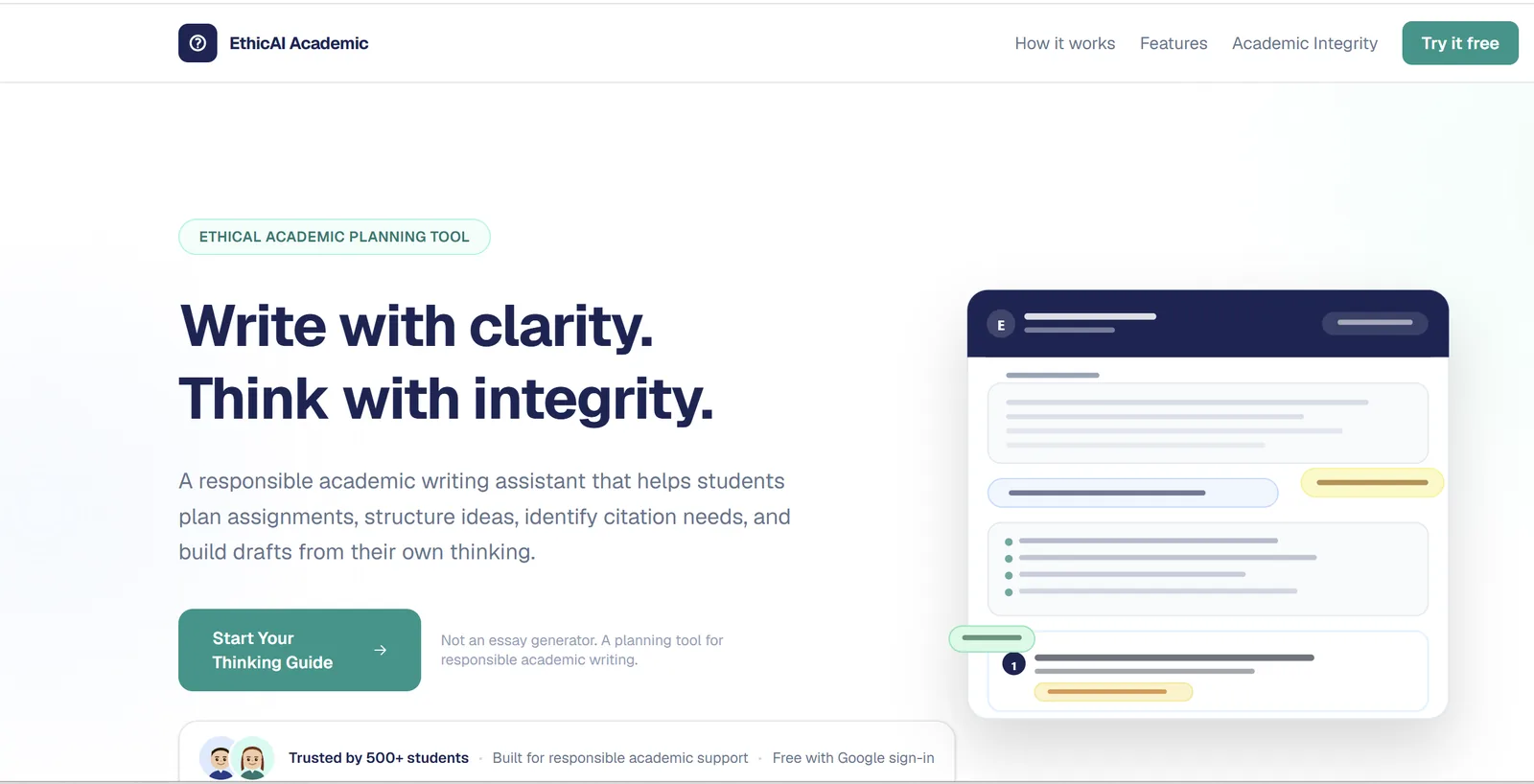
A live web tool that coaches students through structured thinking on an assignment — planning, questioning and evaluating their own reasoning — instead of generating answers for them.
Technical Project Ongoing· Last updated 28 July 2026
Try it live ↗
Overview
The Assignment Thinking Assistant is a live, publicly deployed web application
I built to put my research principles into working software. Rather than
producing text a student could submit, it is designed to scaffold the
student’s own thinking about an assignment — prompting planning, questioning
assumptions and structuring reasoning — so that AI assistance strengthens
epistemic agency instead of substituting for it.
Most generative-AI writing tools optimise for producing finished text quickly.
That is exactly the failure mode my research is concerned with: it can
displace the thinking assessment is meant to develop and certify. I wanted to
test whether a tool built the other way around — optimising for the quality of
the student’s thinking process, not the fluency of an output — was practically
buildable and usable.
My role
Designed and built the application end-to-end: interaction design, prompting
strategy, and deployment.
Research question
Can an AI-assisted tool be designed so that its primary output is improved
student reasoning — planning, self-questioning, evaluative judgement — rather
than submittable text, while remaining genuinely useful enough that students
would choose to use it?
Method
Applied design research: building a working prototype, using it against real
assignment prompts, and iterating the interaction flow based on where it
either produced usable text (a failure mode to close off) or produced genuine
thinking prompts (the intended behaviour).
Tools
TypeScript web application, deployed on Vercel; prompt design grounded in the
Academic Integrity Decision Framework and the Responsible Human–AI Content
Workflow developed elsewhere in this portfolio.
Process
The assistant guides a student through an assignment brief by asking
structuring questions — what is actually being asked, what counts as evidence,
what the student already thinks and why — rather than drafting content on the
student’s behalf. This mirrors the “AI assists, human authors” boundary at the
centre of my academic-integrity research.
Findings
Not yet formally evaluated. Early informal use suggests it succeeds at
prompting planning and self-questioning rather than producing submittable
text, but I have not measured this against a control condition.
Not yet formally measured — the tool is newly deployed.
Limitations
A single well-designed interaction flow cannot guarantee a student engages
thoughtfully with it; determined misuse of any tool remains possible.
Not yet formally evaluated against learning outcomes.
Built and maintained by one developer; feature scope is intentionally narrow.
Lessons learned
The hardest design problem was not the AI prompting — it was resisting the
temptation to make the tool more “helpful” in ways that quietly turned it
back into an answer-generator.
Related publication
Not yet linked to a publication; it is a standalone applied demonstration of
the research principles described above.
Downloadable materials
No downloadable materials — this project is a live web application.
A documented, human-led workflow in which AI assists with drafting, organising, coding and formatting while humans remain responsible for meaning, accuracy, ethics and final approval.
Key insight — Most corrections happen at the verification stage, not the drafting stage — AI-assisted first drafts are rarely wrong in an obviously detectable way.
A six-question framework that structures fair, consistent decisions about student generative-AI use in assessment.
Key insight — Separating disclosure failures from authorship failures stops honest, permitted-but-poorly-acknowledged AI use from being treated as contract cheating.
Conceptual synthesis · Case testing · Policy analysis